
New Caledonia Culture
Ethnicity, Language, Religion (2013)
- Nationality: New Caledonian.
- Population: 264,022.
- Ethnic Groups: Melanesian 44.1%, European 34.1%, Wallisian & Futunian 9%, Tahitian 2.6%, Indonesian 2.5%, other 7.7%.
- Religions: Christian 90%, other 10%. (Christian = Roman Catholic 60%, Protestant 30%).
- Languages: The official language is French. There are more than 30 local dialects that have a mix of Melanesian and Polynesian influences.
- Literacy: 96.2%.
New Caledonia is a multi-cultural society consisting of mainly Melanesians (Kanak) and European (French). The remainder are mainly Polynesian and Asian. The official language of New Caledonia is French while some English is spoken by those in the tourism industry. There are also an estimated 30 Kanak dialects.
History
New Caledonia has a colourful history. Melanesians arrived about 1500 BCE followed by Polynesians in 1100 AD. The islands were first sighted by Europeans in 1774 by Captain James Cook on his second South Pacific voyage. Sandal wood traders, whalers, and missionaries followed, which led to many deaths due to introduced European diseases. In 1853, New Caledonia became a French colony and was used as a penal colony starting in 1864 for the next four decades. Today there is a strong movement and progress toward New Caledonia gaining independence from France.
Kanaks
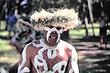 Dance is very important to the native people (the Kanak). The pilou dance for example is a story that encompasses subjects as diverse as birth, marriage, battle, and even cyclones. Colonial authorities originally banned this dance due to the trance-like state it induced and for the ocassional case of cannabilism. Music is also important. Musical instruments used include percussion instruments, bamboo flutes, and conch shells.
La coûtume, a code of rites and rituals is an essential component of social interaction between the clans of the Kanak and their connection to their ancestors. The clan is much more important than individuals in Kanak culture. The Kanak are Melanesian in race, a black people related to the Papuans and Australian Aborigines.
French New Caledonians
White New Caledonians known as Caldoches are the descendents of French convicts and early nickle miners. They have their own unique culture which bears little semblence to France today and is more akin to rural America where rodeos and country fairs feature. Temporary French citizens who come to New Caledonia for work are called Métros.
Food
New Caledonia's traditional food includes fruit and vegetables such as banana, coconut, taro, sweet potato and yam. Sea food includes: fish, lobster, crab, turtle, and dugong. Land animals include the roussette and flying fox a type of bat. In modern times, much traditional food is being replaced by processed and canned foods. Bougna is still popular. It is a dish comprising of banana, taro, sweet potato, yam, chicken, and crab or lobster, all wrapped in banana leaves and cooked in a pit under the ground.
Restaurants especially in Noumea serve typical French dishes and there is also an increasing amount of Asian foods and dishes. Both wine and coffee in Noumea are excellent.
Author & photographer: David Johnson (Virtual New Caledonia). Providing a credit or link is appreciated.
Our content: logos, site names, text, photos, and website design are protected by international copyright law.
Original versions of our photos can be purchased / licensed & web versions can be shared subject to conditions.